

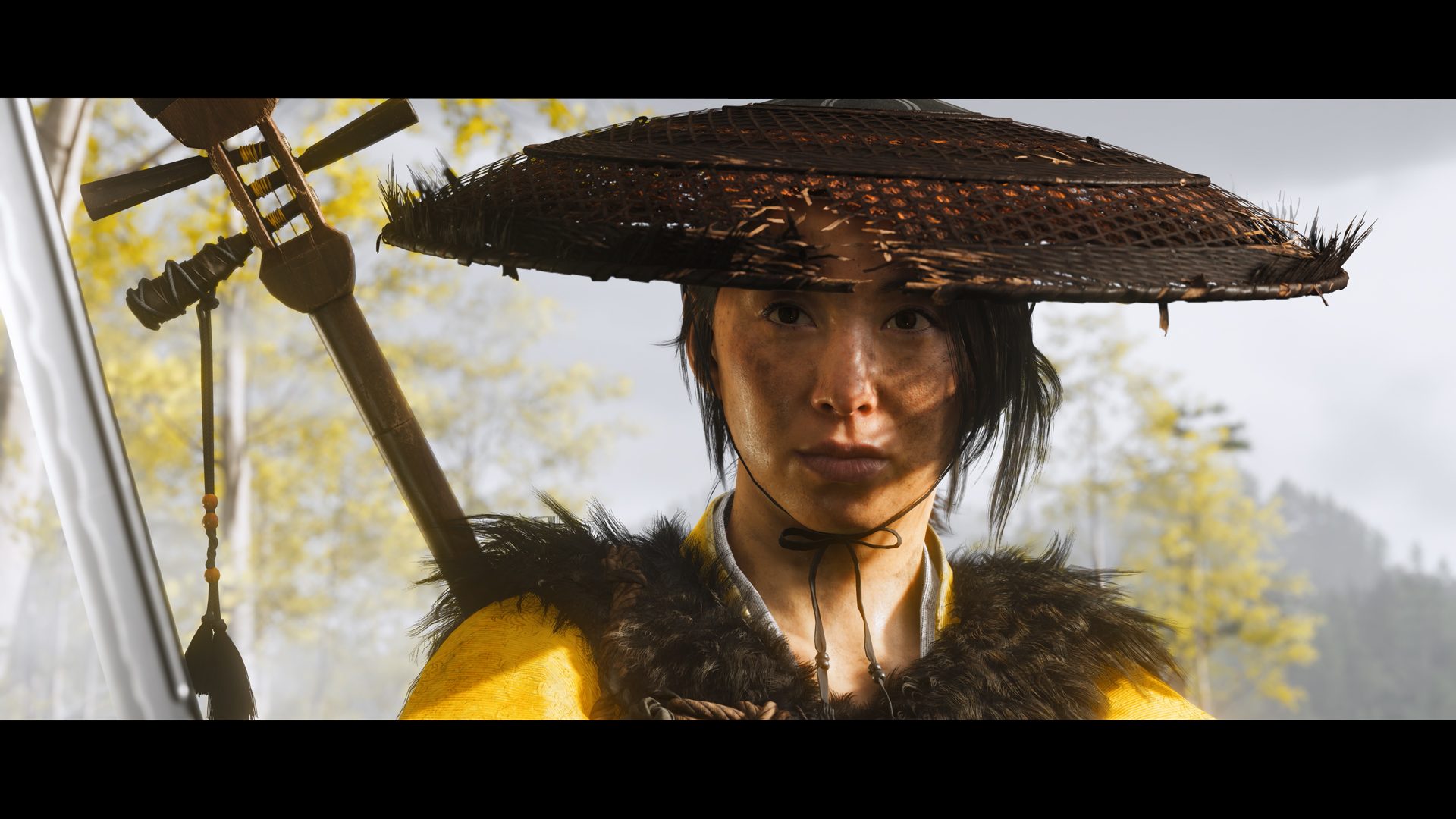
When Sucker Punch Productions introduced Jin Sakai’s journey in Ghost of Tsushima, it proved that open-world design could rely on diegetic environmental cues—like blowing wind and guiding birds—rather than cluttered mini-maps and floating objective markers. In Ghost of Yōtei, the studio pushes that philosophy into new territory, shifting centuries forward to the untamed wilderness surrounding Mount Yōtei in 1603 Japan.
Centering its story on Atsu—a lone mercenary seeking redemption across the northern frontier of Ezo—Ghost of Yōtei delivers a poetic, visceral, and visually stunning samurai adventure.
The Northern Frontier: A Visual Marvel
Set in the rugged lands surrounding Mount Yōtei (modern-day Hokkaido), the environment itself acts as a central character. Powered by Sucker Punch’s upgraded PS5 engine, the landscape bursts with color and movement. Grasslands sway dynamically under mountain gusts, snow deforms realistically under Atsu’s footsteps, and volumetric sunrise lighting through autumn forests creates picture-perfect moments around every trail bend.
Exploration remains wonderfully unguided. Players follow wind gusts, rising smoke columns, and distant landmarks to discover hidden hot springs, sword shrines, and ronin encampments. By stripping away clutter from the HUD, Ghost of Yōtei pulls you directly into its world, making organic discovery feel genuinely earned.
Dual-Blade Mastery: Combat Evolution
While Ghost of Tsushima focused heavily on Jin’s traditional katana stances, Atsu’s arsenal introduces aggressive dual-blade combat alongside long-range firearms and throwable tools.
Core Combat Improvements
- Dual-Wield Stances: Atsu can seamlessly transition between classic single-sword parry stances and fast-flowing dual-katana combinations that shred aggressive enemy block meters.
- Firearm Integration: Matchlock rifles and flintlock sidearms provide sudden, devastating ranged options during multi-enemy skirmishes, though long reload times require precise tactical positioning.
- Defensive Counters & Deflections: Precision parries trigger cinematic counter-strikes, with camera angles tightening to emphasize high-impact final blows.
Combat feels fast, bloody, and deliberate. Button-mashing is quickly punished by aggressive bandit leaders and mercenary ronin, forcing players to master parry timing, posture breaks, and stance-switching on the fly.
Story, Character, and Mythos
Unlike Jin Sakai’s duty-bound struggle against an invading army, Atsu’s narrative is a personal tale of survival, mercenary rivalries, and vengeance across a lawless borderland.
Ezo is populated by distinct factions—displacement camps, rogue samurai clans, and local trade settlements—each offering multi-stage side quests that flesh out the region’s socio-political tension. Furthermore, the game weaves Japanese folklore into optional mythic tales, leading to memorable boss encounters against legendary swordsmen and mythic warriors.
The recent Ghost of Yōtei: Legends update further expands the package, adding two-player co-op story missions and four-player wave survival modes where teams face off against supernatural threats inspired by mythology.
Technical Performance on PlayStation 5
Running natively on PS5 hardware, Ghost of Yōtei offers two distinct graphics modes:
- Performance Mode: Dynamic 4K resolution targeting a buttery-smooth 60 FPS, essential for timing split-second combat parries.
- Fidelity Mode: Native 4K at 30 FPS featuring enhanced foliage density, contact shadows, and ray-traced reflections.
Load times are practically non-existent; fast-traveling across the massive map takes less than two seconds thanks to the console’s ultra-fast SSD.
Final Verdict
Ghost of Yōtei is Sucker Punch operating at the peak of its powers. By pairing an incredible protagonist with refined dual-blade combat and unmatched environmental art design, it stands as one of the finest action-adventure games of the generation. It is an absolute must-play for PlayStation 5 owners.
Discussion & Responses